


ANUWELL · THE PROTOCOL · THE FILES
You are packing for ten days away and your medication is in the refrigerator. It needs to stay cold, it needs to get through security, and at some point on the other end you will need to use it.
This is one of the most common reasons people pause a protocol, and it is almost always avoidable. The logistics are manageable once you know them. What catches people out is discovering the rules at the airport, or at customs in a country with stricter medication laws than the one they left.
A trip should not cost you three weeks of progress.
Most of the work is done before you leave the house.
- Carry-on
- always, never checked baggage
- Declare it
- medically necessary liquids are exempt from limits
- Weeks ahead
- for international travel with controlled medication
The rule that matters most
Never put it in checked baggage
Checked bags get delayed, misrouted, and occasionally lost. The cargo hold also swings through temperature extremes that nothing temperature-sensitive should experience. Both the TSA and most airlines advise keeping medication in your carry-on for exactly these reasons. 1
If your carry-on gets gate-checked on a full flight, take the medication out and keep it with you. A small insulated pouch that fits under the seat solves this permanently.
Getting through security
What TSA actually allows
Injectable medication, syringes, and the cooling you need to keep it viable are all permitted. The rules are more accommodating than most people expect, and knowing them turns a stressful moment into a routine one.
Practically: take the medication bag out before you reach the belt, tell the officer you have medically necessary liquids and a cooling pack, and put it in its own bin. Allow a few extra minutes. Officers do this every day, and the interaction is usually brief.
Keeping it viable
Cold storage on the move
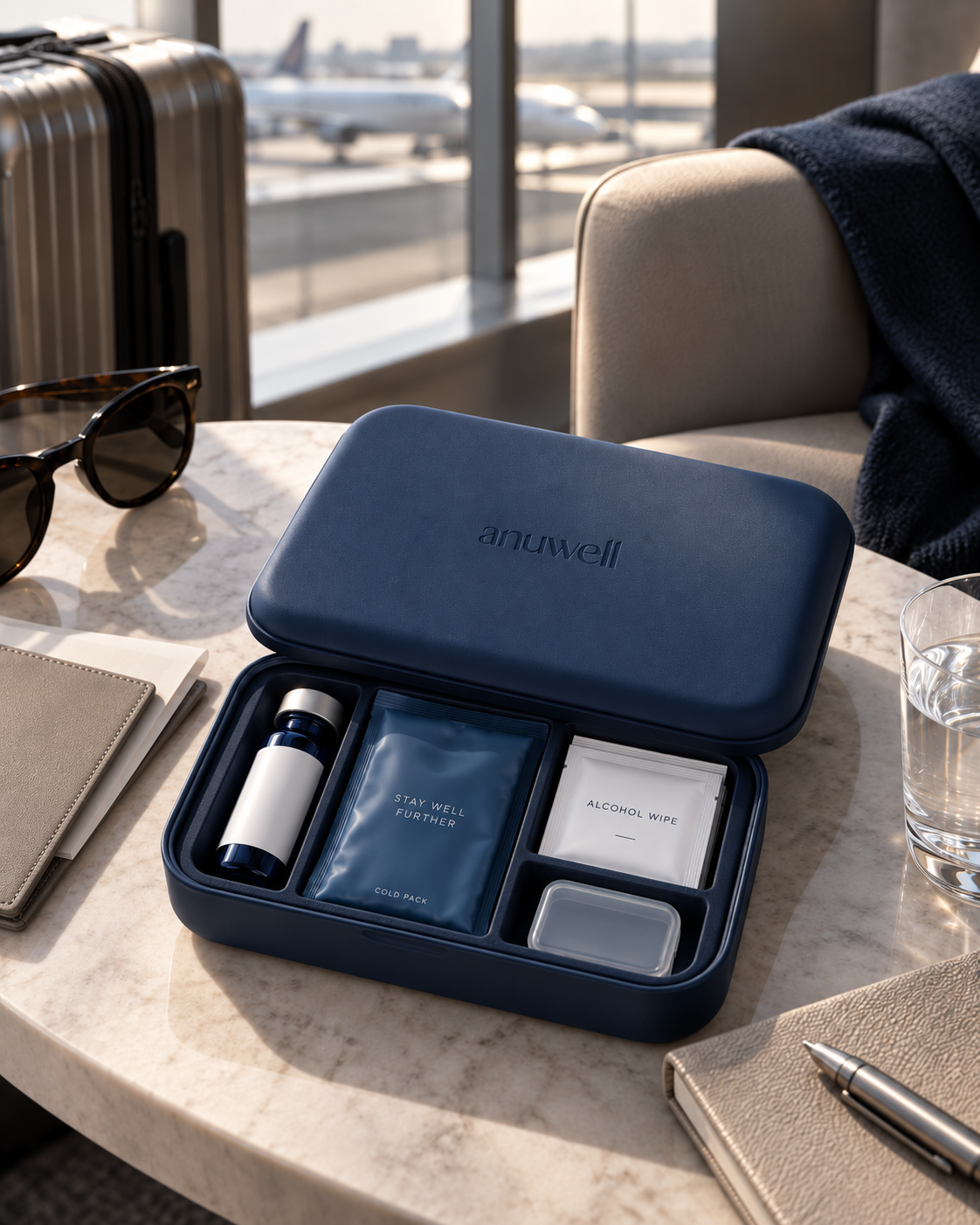
Storage requirements vary by therapy and by whether a vial has been mixed. Your pharmacy label and your clinician set the window for your specific medication, and that is the instruction to follow rather than anything general you read.
What travel adds is the challenge of holding that window while you are moving. A few things that help:
- Use a purpose-built medication travel case. An insulated case with gel packs designed for medication holds temperature far more reliably than a lunch bag, and several models hold a stable range for a full travel day.
- Freeze gel packs solid before you leave. They are permitted in either state, and starting frozen buys you hours.
- Ask a flight attendant on long flights. Many can top up ice. Do not count on it, and it is a useful backup on a delay.
- Treat the hotel minibar with suspicion. Minibar compartments are often warmer than a true refrigerator and some cycle off entirely. Ask the front desk for a proper medical-grade or kitchen refrigerator, which most hotels can arrange, and confirm the temperature rather than assuming.
- Protect against leaks and pressure. Cabin pressure changes can push liquid past a stopper. Keep vials upright, in a hard-sided case, inside a sealed bag so a leak stays contained rather than ruining what is around it.
Worth asking your pharmacy before a long trip
- Whether your therapy is available in a form that travels more easily for the length of your trip.
- Whether pre-filled syringes are an option for you. Some pharmacies can prepare them, which removes handling from a hotel room. This is a pharmacy decision rather than something to do yourself, because sterility and stability are part of the answer.
- What their guidance is if your medication is exposed to heat or falls outside its storage range while you are away.
- Whether an early refill is possible so you travel with what you need without cutting it close.
Paperwork
What to carry, and why
Domestic travel rarely requires anything beyond a labeled container. International travel is a different situation, and the cost of being underprepared is your medication being confiscated in a country where you cannot replace it.
- Original pharmacy labels on every container, matching the name on your passport.
- A copy of your prescription, paper and a photo on your phone.
- A letter from your prescribing clinician stating the condition being treated, the medication, the dose, the quantity you are carrying, and that it is for personal use. For international trips, request this well before you leave.
- Your clinician's contact details, so a question can be answered rather than escalated.
The part people find out too late
International travel and controlled medication
Testosterone is a controlled substance in the United States, and many countries regulate hormone therapies and other prescription medications more tightly than the US does. A medication that is entirely routine at home can require advance government approval elsewhere, or be prohibited outright.
Two examples show the range. The UAE requires travelers carrying controlled medication to apply for approval through the Ministry of Health website before the trip. 2 Japan requires an import certificate for injectable medications, medications containing a controlled substance, or quantities beyond the standard personal allowance, applied for in advance through the health ministry's system. 3
Neither process is difficult. Both take time, and neither can be completed at the airport.
Before an international trip
- Start four to six weeks out. Approval processes and clinician letters both take longer than you expect.
- Check the embassy or consulate website of your destination, and of anywhere you connect through, since transit countries have their own rules. Verify each time rather than relying on what was true last year.
- Ask your clinician about quantity. Many countries allow a 30 to 90 day personal supply, and some require a permit above a set amount.
- If your medication cannot enter your destination legally, that is a conversation with your clinician about the trip, not a problem to solve at the border.
Nothing about a vacation is worth a customs detention.
Check the rules, carry the paperwork, and travel without thinking about it again.
When you land
Check everything immediately
Open the case as soon as you reach your accommodation rather than on the morning of your next dose. You are looking for leaks, cracked vials, a cooling pack that failed, or anything that looks different from when you packed it.
Checking on arrival is what gives you time. A problem found on day one is a call to your clinician with several days to arrange something. The same problem found on day four, in a different time zone, is a missed dose you cannot do anything about.
If something looks wrong, do not use it and do not guess. Contact your care team, describe what you are seeing, and let a clinician tell you what to do. Never adjust your schedule or dose on your own to compensate for a travel problem.
Before you leave
The packing checklist
- Medication in carry-on, in a hard-sided insulated case, in a sealed bag, vials upright.
- Gel packs frozen solid at departure.
- Original labels intact on every container.
- Prescription copy and clinician letter, on paper and on your phone.
- Sharps container or hard-sided container for used syringes.
- A few extra supplies beyond what the trip requires, in case of delays.
- Destination and transit rules confirmed, with any required approval already granted.
- Your care team's contact details saved somewhere you can reach them from abroad.
ANUWELL
Tell us before you go
Travel is a normal part of life and your protocol should accommodate it. Let your care team know about a trip in advance and a clinician can look at refill timing, discuss whether anything about your schedule should shift around long flights or time zones, and prepare the documentation you will need.
The trips that go badly are almost always the ones nobody knew about. A short message before you book saves the scramble later.
Sources
References
- Transportation Security Administration. What Can I Bring? Medications, syringes, and gel ice packs; and Travel Tips for passengers with medical conditions. tsa.gov.
- Embassy of the United Arab Emirates, Washington DC. Permitted Prescriptions and Drugs While Entering the UAE. uae-embassy.org.
- Ministry of Health, Labour and Welfare (Japan). Import confirmation procedures for personal importation of medicines.
- International Narcotics Control Board. Country regulations on carrying medicines containing controlled substances for personal use. incb.org.
Important
This article provides general education and travel logistics, not medical or legal advice. Follow the storage instructions on your pharmacy label and the guidance your clinician gave you. Do not adjust your dose or schedule on your own, and contact your care team about any medication that may have been compromised.
Security, customs, and import rules vary by country and change over time. Confirm current requirements with the relevant embassy or authority before you travel. Compounded medications are not FDA-approved and are not reviewed by the FDA for safety or effectiveness. Prescriptions are issued only where clinically appropriate following review by a licensed clinician. Individual experiences vary.